Dallas entered the 1970s as a city undergoing rapid expansion. Between the 1960 and 1970 census, the city’s population grew by 24.2%, from 679,684 to 844,401 residents. This surge made Dallas the eighth-largest city in the United States. Yet, beneath the surface of this growth was a community defined by deep social and racial divisions.
Despite the legal advancements of the Civil Rights Movement, Dallas in 1970 was ranked the fourth most segregated city in the nation. Housing was strictly separated, with the majority of the city’s Black residents living in designated areas like South Dallas and Oak Cliff. This residential segregation was the result of decades of policy and social pressure, which in the 1950s included a series of dynamite bombings targeting Black families who moved into white neighborhoods. The city’s social geography was further shaped by “white flight”; between 1960 and 1970, the Anglo population of Dallas proper fell from 77% to 67%, while the surrounding suburbs became 94% white.
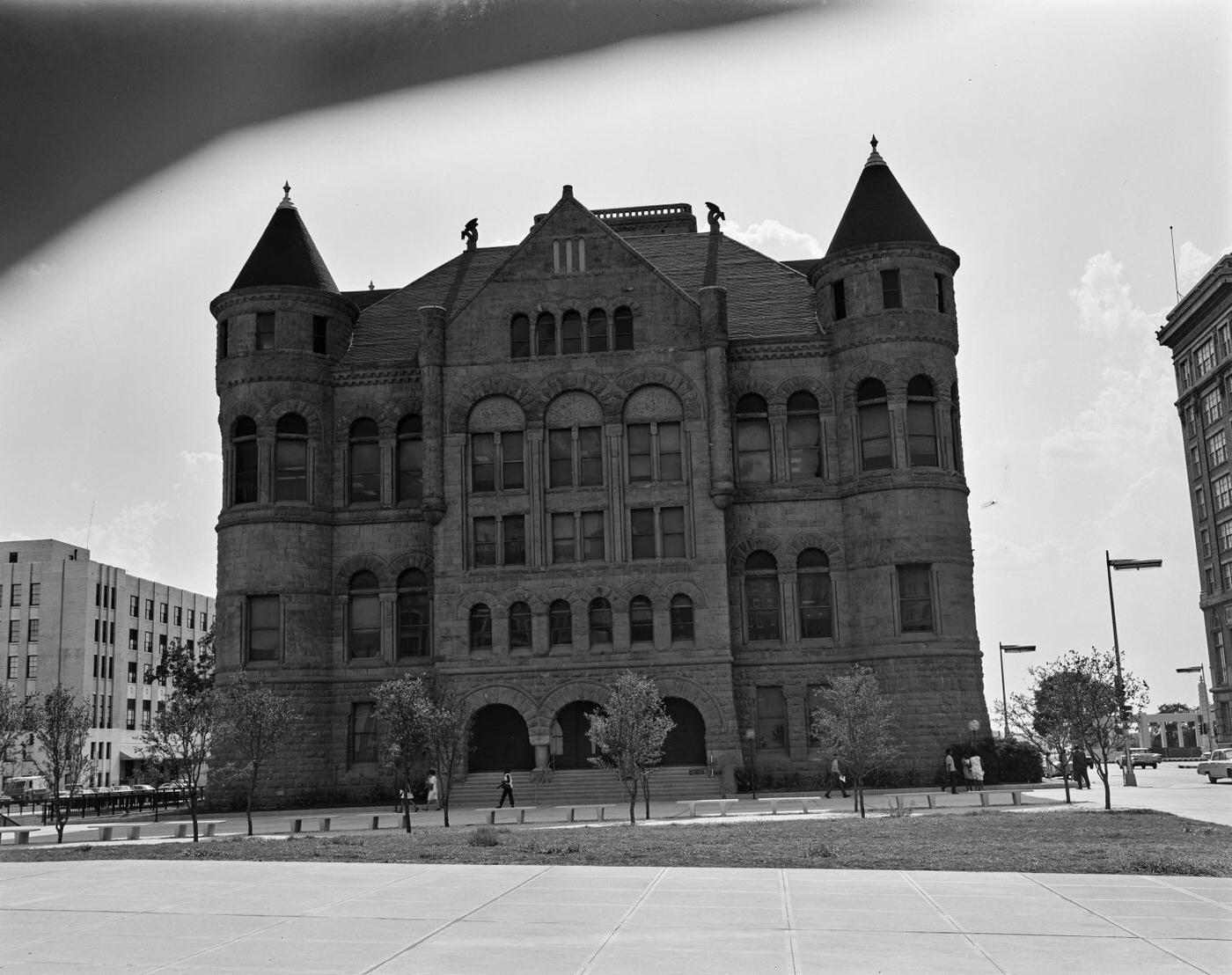
The Dallas County Courthouse (located at Houston at Commerce Streets) in Dallas, Texas.The Aldredge House (located at 5500 Swiss Avenue) in Dallas, Texas, 1978.Hall of State, Fair Park, built for the Texas Centennial in 1936.Looking south along North Central Expressway under an overpass to the Meadows and Noel Page buildings and the University and Yale exits, 1972.
Aerial color the Dallas skyline, 1976.East facade of the old Dallas County Courthouse – Old Red, 1976.Dallas skyline aerial view, 1972.Dallas skyline aerial view with most of the buildings located on the center left and the Dallas Convention Center on the right, 1974.
The MK&T Building in Dallas, Texas, 1978.Swiss Ave Hist. in Dallas, Texas, 1979.Historic property in Texas.9400 Rockbrook in Dallas, Texas, 1970.
The Arcadia Park School (located at 911 N Morocco) in Dallas, Texas.Group of children standing on the sidewalk in front of the Arcadia Theatre in Dallas, Texas; the movie “Big Time” with Lee Tracy and Mae Clark is advertised,2714, 2708, 2700 South Boulevard in Dallas, Texas, 1977.2522, 2516 Park Row in Dallas, Texas, 1977.
2606, 2602 Park Row in Dallas, Texas, 1977.The Caruth House (located at 7800 Block N Central Expressway) in Dallas, Texas.Construction work at the Dallas Farmer’s Market.Landing at Love Field with a plane on the right landing and two planes on the left preparing for take off; the Dallas skyline is shown in the background.
The Gano House in Dallas, Texas.The C.M. Gordon Building (located at 813 W Jefferson) in Dallas, Texas.Virginia Hall – SMU (located at 3325 Dyer St) in Dallas, Texas, 1979.5907 Swiss in Dallas, Texas.
Aerial view of Downtown Dallas, 1970s.Historic property in Texas.The Bandstand in Dallas, Texas, 1976.The Fisher House (located at Old City Park) in Dallas, Texas, 1976.
Big Tex with a stylized American flag shirt with a Lee jeans logo, 1970s.Large construction site at Dallas Love Field Airport with the Dallas skyline in the background.The Brown Farm (located at 4802 Lovers Lane) in Dallas, Texas, 1976.Greenway Parks in Dallas, Texas.
The Carriage House (located at 2723 Swiss Avenue) in Dallas, Texas, 1977.Lines outside the Coliseum in Fair Park for the exhibition “Pompeii A.D. 79,” held at the Dallas Museum of Fine Arts, 1979.The Warehouse Buildings (located at north of Goodall-Rogers Freeway) in Dallas, Texas, 1978.The Missouri-Kansas-Texas Depot Record in Dallas, Texas, 1978.
The Mouzon House (located at 3444 University Drive) in Dallas, Texas, 1978.The Old Spaghetti Warehouse (located at 1815 N Market St) in Dallas, Texas, 1978.Front view of El Buen Pastor featuring a light-colored wooden frame and steps that lead to a double-doored entrance.Dallas Farmer’s Market while under construction.
Historic property in Texas.Cones in front of a building at Dallas Love Field Airport; a taxi cab is also parked in front of the building.Fire Chief Funk and Assistant Fire Chief L. M. Long standing in partial uniform next to the Chief’s Car parked in front of a concrete building.El Centro College expansion site, 1977.
The Block Building (located at 829 W Jefferson) in Dallas, Texas.Dallas Museum of Fine Arts at Fair Park with a large statue and several children in front of the museum, 1970s.Large, dense shrubs bordering the front porch of a two stories, wood-paneled house, 1979.The Dallas Hall (located at Southern Methodist University Campus) in Dallas, Texas, 1978.
Dallas skyline as seen from the future Arts District – Woodall Rodgers areas, 1976.Outside of Dallas Love Field Airport with some cars and maintenance vehicles, as well as the rear of an airplane on the left side.Closed garages of a Sear’s locomotive center, 1977.Turtle Creek, a river and park in Dallas with a family walking along the river bank, 1977.
Loading dock for Hardie’s Fruit and Vegetable Co. with a truck parked next to the dock and children sitting on the truck bed surrounded by bags of produce.The Buckner Home Cullom Hall (located at 5200 Buckner) in Dallas, Texas.Aerial overview of a small community of homes connected by a system of paved roads on the shore of Lake Ray Hubbard.The Big D. Sewing Machine-Old County Jail (located at 701 and 703 Ross) in Dallas, Texas, 1978.
Fair Park in Dallas, Texas.The Mouzon House (located at 3444 University Drive) in Dallas, Texas, 1978.2730, 2726, 2722, 2718, 2714 Park Row in Dallas, Texas, 1977.The Oak Lawn Fire Station (located at Cedar Springs Rd & Reagan St) in Dallas, Texas, 1977.
The Buckner Home Administration (located at 5200 Buckner) in Dallas, Texas.The Southern Methodist University Stadium (located at Southern Methodist University Campus) in Dallas, Texas, 1979.The Stanley Patterson Hall – SMU (located at 3128 Dyer St) in Dallas, Texas, 1979.2603, 2607, 2611 Park Row in Dallas, Texas, 1977.
The Munger Place in Dallas, Texas, 1977.The Oak Lawn Fire Station (located at Cedar Springs Rd) in Dallas, Texas, 1975.Firefighters and mobile intensive care officers tending to a car flipped in the middle of a two-lane street.Fallen cable car in a carnival skee-ball booth, 1979.
Young woman accepting an award at the Dallas Farmer’s Market.James Doherty mowing a lawn, 1977.Mt. Pisgah Baptist Church.View along Interstate-30 at Akard Street, with the Ramada Inn to the left, 1973.
Anderson Memorial Church, also known as “El Divine Salvador,” on Carlisle Street in Dallas, Texas.Construction site at Dallas Love Field Airport with a building under construction in the foreground and several airplanes in the background.The Caruth House (located at 7701 Southwestern Boulevard) in Dallas, Texas, 1970.The Fondren Science Building (located at Southern Methodist University Campus) in Dallas, Texas.
The Aldredge House (located at 5500 Swiss Avenue) in Dallas, Texas.2525, 2529 Park Row in Dallas, Texas, 1977.The Blake Jacobs Turner (located at Oak Cliff South of Fine Arts, 401 North Rosemont) in Dallas, Texas.The Drummer’s Hotel (located at Old City Park) in Dallas, Texas, 1976.
The Shadow of the Sixties: The “City of Hate” and the “Dallas Way”
Dallas began the 1960s, still trying to escape the “City of Hate” reputation it had acquired after the assassination of President John F. Kennedy on November 22, 1963. The event was a profound trauma for the city, forcing what its leaders called a period of “self-examination”.
For decades, the city’s civic and political life had been governed by a system known as the “Dallas Way”. This informal power structure consisted of a small group of white business executives and clergy who managed Dallas’s social and economic affairs. Their primary goal was to maintain a stable environment for business, which meant controlling processes like desegregation through quiet, top-down negotiations to prevent the public violence that had disrupted other Southern cities.
The “Dallas Way” found its most ambitious expression in the “Goals for Dallas” program. Initiated in 1964 by Mayor J. Erik Jonsson, a co-founder and chairman of Texas Instruments, the program was a direct response to the city’s tarnished national image. It was a comprehensive, long-term plan designed to map out the city’s future and reshape its identity.
The program was modeled directly after the corporate planning system used at Texas Instruments, reflecting a business-centric approach to civic management. Though created by the business elite, it was a massive public undertaking, involving over 100,000 residents who attended neighborhood meetings to help develop hundreds of specific goals. These goals covered a wide range of topics, from transportation and education to economic development and public safety. As Dallas entered the 1970s, this program served as the official blueprint for its transformation. It was the driving force behind the decade’s most significant public works, including the construction of a new international airport and a new city hall.
This strategic rebranding effort, however, operated on a track parallel to the city’s more contentious social issues. The focus on large, visible infrastructure projects allowed the city’s leadership to project an image of a modern, forward-thinking metropolis. This carefully constructed narrative of progress stood in contrast to the ongoing resistance to racial integration in other areas of civic life, particularly in the city’s public schools.
The 1970s saw the physical realization of the “Goals for Dallas” vision. A series of monumental construction projects, unprecedented in their scale and ambition, fundamentally reshaped the city’s landscape and infrastructure. These projects were not merely functional; they were architectural statements designed to project a new image of Dallas as a modern, world-class city.
Large group of people taking shelter under a picnic shelter during the Band Concert and Community Program at Moore Park.The Old City Jail (located at 707 Ross) in Dallas, Texas, 1979.2734 South Boulevard in Dallas, Texas, 1977.The Purse and Company Wholesale (located at 601 Elm Street) in Dallas, Texas, 1975.
The Bowie School (located at 301 North Lancaster) in Dallas, Texas.Group of children leaning over the wall that separates them from the exhibit to see the animals below.Aerial view of Martin Weiss taken from the South-East, 1977.The Gano House (Old City Park) (located at 1717 Gano) in Dallas, Texas, 1974.
Crowds gathering on the streets to see a parade float drawn by a team of four horses.Construction work being done at the Dallas Farmer’s Market.The Andy’s Auto Center (located at 310 North Market) in Dallas, Texas, 1978.2316 Park Row in Dallas, Texas, 1977.
The DeGoyler House (located at Garland Road) in Dallas, Texas.The General Store (located at Old City Park) in Dallas, Texas, 1976.The Higginbotham-Pearlstone Hardware Company (located at 1701 Market) in Dallas, Texas, 1978.Fountain on the West side of the Mountain View campus, 1970.
Dallas-Fort Worth International Airport (DFW): A Regional Gateway
For decades, Dallas and Fort Worth had been locked in a rivalry over air travel, with each city promoting its own airport—Love Field in Dallas and Amon Carter Field in Fort Worth. Federal pressure and the needs of the jet age finally forced a compromise, and in 1968, the two cities agreed to build a joint regional airport.
Ground was broken in December 1968 on a vast tract of prairie land—17,500 acres—located between the two cities. The construction was a massive undertaking, costing $875 million. The airport was officially dedicated in a multi-day ceremony in September 1973 and became fully operational on January 13, 1974. The first commercial plane to land was American Airlines Flight 341.
At the time of its opening, DFW was the largest airport in the world by land area. Its initial facilities included four terminals, three runways, 66 gates, and a 600-room hotel. The project was a crowning achievement of the “Goals for Dallas” program and was overseen by mayors J. Erik Jonsson and his successor, Wes Wise. The sheer scale of the airport sent a clear message of global ambition, transforming the region into a major national and international transportation hub.
Aerial shot of Love Field with several people walking around the airport and Bachman Lake in the background.Fire truck in front of fire station number 21 at Dallas Love Field Airport; the words “Dallas Love Field” are shown on the left side of the truck.Row of parked cars at Dallas Love Field Airport with an airport building under construction in the background.Fenced off construction area near the east concourse at Dallas Love Field Airport, 1980.
Construction site and construction workers at Dallas Love Field Airport with scaffolding in front of a building on the right.Exterior of Dallas Love Field Airport with several cars on the street next to the airport.The Dallas Hall (located at Southern Methodist University Campus) in Dallas, Texas, 1976.Two story building extracting fire and dark smoke from the rooftop with several fire hoses coming from the fire engines parked outside the building; a tall sign with the text “CRYSTAL ICE KegBeer” is visible,
Aerial view of Downtown Dallas, 1970s.The American Pre-Package Co. building with wooden crates stacked beneath an awning and a small truck parked on the street.The Aldredge House (located at 5500 Swiss Avenue) in Dallas, Texas, 1978.The Ablon Poultry & Egg Co. storefront with crates stacked against the loading dock and a truck packed with crates parked on the right side.
Two billboards on the outskirts of Dallas; the billboard on the right is an advertisement for Kroger, while the one on the left is promoting a gun show, 1979.2634, 2626 South Boulevard in Dallas, Texas, 1977.The Alfred H. Belo Home (located at 2115 Ross Avenue) in Dallas, Texas, 1974.The Alexander Home (located at 4607 Ross) in Dallas, Texas, 1970.
2734 South Boulevard in Dallas, Texas, 1977.Aerial overview of the Las Colinas region focused around highways 114 and 348, 1974.Aerial view of Love Field looking southwest with no aircraft at terminal, 1972.The Alfred H. Belo Home (located at 2115 Ross Avenue) in Dallas, Texas.
24, 2424 Park Row in Dallas, Texas, 1977.The Hodge Podge (located at 2603 Fairmont) in Dallas, Texas, 1976.The Magnolia Building (located at 108 South Akard) in Dallas, Texas, 1977.The inlet side of Bachman Bypass gates before the removal of debris, 1974.
Angela and Dion Pride standing next to their bicycles outside of their home in Dallas, Texas, 1971.Aldredge House on Swiss Avenue, 1976.2401, 2409, 2415 South Boulevard in Dallas, Texas, 1977.The Oak Lawn Fire Station (located at Cedar Springs Rd & Reagan St) in Dallas, Texas, 1977.
441 South Dallas Street in Dallas, Texas, 1975.Woman and three young boys seated around a rectangular table, coloring during a summer program at the South Dallas Cultural Center.The Green Brothers (located at 2019 North Lamar) in Dallas, Texas, 1978.The Melrose Building (located at 712 Commerce) in Dallas, Texas, 1978.
Mt. Moriah Baptist Church.The Lakewood Library (located at 6121 Worth) in Dallas, Texas, 1976.The Dallas Hall (located at Southern Methodist University Campus) in Dallas, Texas, 1978.2734 South Boulevard in Dallas, Texas, 1977.
The Wilson Block (located at 2907 Floyd) in Dallas, Texas, 1977.The Wilson Block (located at 2906 Swiss) in Dallas, Texas, 1977.Dallas Fire Department Fire Station No. 11, located at 3828 Cedar Springs Rd, Dallas, TX 75219.Dallas Farmer’s Market from a distance.
Cummings Park and its surrounding area in Dallas, Texas, 1977.The Alfred H. Belo Home (located at 2115 Ross Avenue) in Dallas, Texas.Portrait of the Dallas Fire classmembers from July 16, 1979 to December 14, 1979 posing outside a building in two rows, 1979.The Sear and Roebuck Club (located at 1409 South Lamar) in Dallas, Texas, 1976.
Conner Produce Company set up at the Dallas Farmer’s Market with boxes of produce are stacked on a raised cement platform.The Wilson Block (located at 2723 Swiss Avenue) in Dallas, Texas, 1977.2634, 2630, 2626 Park Row in Dallas, Texas, 1977.Casa Linda Park and its surrounding area in Dallas, Texas, 1977.
Looking southwest on Inwood Road from Maple Avenue, 1971.Station House Number 18, Dallas Fire Department, 1974.The Virginia Hall (located at Southern Methodist University Campus) in Dallas, Texas, 1979.The Dallas Theatre Center (located at 3636 Turtle Creek) in Dallas, Texas, 1970.
Home designed by Hal Thompson on Swiss Avenue, 1976.The Railroad Depot (located at Old City Park) in Dallas, Texas, 1976.2734 South Boulevard in Dallas, Texas, 1977.Texas Food & Fiber Pavilion at Fair Park, 1977.
Large crowd outside of the McKamy Campbell Funeral Home present for Bonnie Parker’s funeral.Storefronts, including Carl Fain & Son Produce, with a car parked next to the street.Mountain View College Site with two cedar trees and a large crane visible in the photograph, 1970.The Munger Place District (located at 4925,4929 Worth) in Dallas, Texas, 1977.
House in rapidly spreading flames as three firemen spray fire hoses toward the fire.The DeGoyler House (located at Garland Road) in Dallas, Texas.2707, 2711, South Boulevard in Dallas, Texas, 1977.The Home Furniture (located at 603 Munger) in Dallas, Texas, 1978.
Kidd Springs Park covered in large sections of dark green trees, 1977.The Braden House (located at 1622 Cedar Hill) in Dallas, Texas, 1976.Western aerial view of Lizzie Oliver Park, Clara Oliver Elementary School, and the neighboring suburban residential homes, 1977.The Hord Log Cabin (located at 501 Shelter Place) in Dallas, Texas, 1976.
View of downtown Dallas, 1970s.Looking north along Central Expressway to the I-635 (LBJ Freeway) exits with a sign for Restland Cemetery visible to the right, 1970.Dallas Fire Station in Dallas, Texas.900-904 Commerce in Dallas, Texas, 1978.
Businesses at Howell and Allen streets, including the House of Wong, 1970.Olde Spaghetti Warehouse restaurant at Market and Munger streets in Dallas’ West End, 1977.Boy at produce stand weighing a basket; he was awarded a ribbon, which he wears on his shirt.The Dallas Freeway, I-30, 1970s.
Busy intersection at N. Lamar and Main streets, looking north toward Ross Ave. and the Universal Building, 1970.Lillie’s Lounge on McKinney at Allen St, 1970.
The Oil Boom
The 1970s were a period of dramatic economic expansion for Dallas, driven by the twin forces of global energy politics and local technological innovation. This boom financed the city’s ambitious civic projects and fueled a period of widespread prosperity. However, it also deepened the city’s reliance on a volatile global market, creating an economic structure that was powerful but unstable.
On October 19, 1973, Arab member nations of the Organization of Petroleum Exporting Countries (OPEC) imposed an oil embargo against the United States in retaliation for its support of Israel during the Yom Kippur War. The embargo triggered a global energy crisis. The price of oil per barrel first doubled, then quadrupled, sending shockwaves through the U.S. economy.
While the rest of the nation faced long gas lines and economic strain, Texas experienced an unprecedented boom. As a major center for oil production and, critically, petroleum financing, Dallas was flooded with capital. This sudden influx of wealth supercharged the state’s economy. The boom led to a surge in investments not only in the oil and gas industry but also in the banking and real estate sectors that supported it. The construction of new office towers and commercial developments transformed the Dallas skyline, a direct result of the money flowing into the city. This period of intense growth, however, exposed the Texas economy’s heavy dependence on the energy sector, making it vulnerable to the fluctuations of the global market. The very forces that funded the city’s transformation were also creating a systemic risk that would lead to a severe economic bust in the following decade.
The General Center Building (located at 1801-1811 Hord Street) in Dallas, Texas, 1978.Looking south on N. Lamar St. from Corbin St, 1970.
The Continental Gin Co (located at 3309 Elm St) in Dallas, Texas.The Sear and Roe Buck Club (located at 1409 South Lamar) in Dallas, Texas, 1976.Looking north along Central Expressway to the Forest Lane and Coit Road exit, 1971.Looking south along north Central Expressway to the Knox-Henderson exit, 1971.
Two buses outside the Circle Theater in Dallas, Texas at the premier of the movie War Wagon; banners on the buses read, “War Wagon Belles, War Wagon, World Premier, Dallas, Sat. May 27, Ft. Worth.”Downtown Dallas skyline including construction in view, 1974.The Continental Gin Co (located at 3333 Elm St) in Dallas, Texas.The Dallas High School in Dallas, Texas.
Pacific Avenue entrance to the Majestic Theater with the stage entrance to the left of the marquee, 1977.The Dallas Fire Station (located at 5501 Columbia Avenue) in Dallas, Texas.The Brent House (located at Old City Park) in Dallas, Texas.Scene from the State Fair of Texas with the Cotton Bowl Stadium visible in the background, 1978.
Reunion Tower: A New Skyline Icon
The decade’s building boom culminated in the creation of a new, instantly recognizable landmark on the Dallas skyline. The Reunion Tower was constructed as part of the Reunion Project, a major urban development that also included the Hyatt Regency Hotel and the revitalization of the historic Union Station.
Designed by the firm Welton Becket & Associates, the 560-foot tower was completed in 1978. Its most distinctive feature is the large geodesic dome at its top, which is illuminated at night by 259 LED lights and houses an observation deck and a revolving restaurant. The GeO-Deck observation level, located 470 feet above the ground, offers panoramic 360-degree views of the city.
Affectionately nicknamed “The Ball” by locals, Reunion Tower immediately became a symbol of the new Dallas. Its futuristic design captured a sense of optimism and progress. The tower’s prominent placement in the opening credits of the internationally popular television show Dallas cemented its status as an icon, broadcasting the city’s modern image to a global audience.
Construction cranes share the Dallas skyline with the Southland Life, Sheraton Hotel, and Gibraltar buildings and with the Medical Arts parking garage, 1977.The Adolphus Hotel (located at Commerce Street) in Dallas, Texas, 1975.The Missouri-Kansas-Texas Freight Station (located at Record St at Munger) in Dallas, Texas, 1978.I-De-Ho Luncheonette at Field Street and Cedar Springs Road, 1975.
The Briggs-Weaver Mach (located at Market at Ross) in Dallas, Texas, 1978.Scene from the State Fair of Texas showing Big Tex greeting fairgoers, 1978.The Snider Hall (located at Southern Methodist University Campus) in Dallas, Texas, 1979.
Dallas City Hall: An Architectural Statement
The city’s effort to redefine itself was also cast in concrete in the heart of downtown. Planning for a new city hall began in 1964 as part of the post-assassination civic renewal. In 1966, the city selected the world-renowned architect I.M. Pei to design the new municipal building. Construction began in 1975, and the new Dallas City Hall was dedicated on March 12, 1978.
Pei’s design was a radical departure from traditional civic architecture. The building is a massive inverted pyramid, with each of its upper floors extending nine feet beyond the one below it. Its concrete facade slopes outward at a 34-degree angle, creating a large, shaded public plaza at its base. Pei explained that the design was both symbolic and functional; the canted facade was a gesture of a government welcoming its citizens, while the larger upper floors provided more office space away from the public-facing ground level.
The structure was built with a buff-colored concrete that Pei chose to reflect the natural earth tones of the region. The project was a centerpiece of the “Goals for Dallas” initiative, a physical embodiment of the city’s desire for a modern and open identity. This bold architectural statement was a conscious effort to build a new symbol for Dallas, one that looked toward the future rather than the past.
Dallas Cowboys defensive end Harvey Martin (No. 79) is seen standing among others in the bleachers in front of Dallas City Hall before a crowd at the victory parade upon the team’s arrival to Dallas from New Orleans after winning Super Bowl XII against the Denver Broncos, 1978.
Memorial in the form of an empty 50-by-50 foot room, 30 feet high, dedicated in Dallas to the memory of President John F. Kennedy, 1970.Loading docks at the Dallas Farmers Market with Pure Ice & Cold Storage loading area, 1977.Ku Klux Klan march led by Nation Knights of the Ku Klux Klan members in downtown Dallas, 1979.The Allis-Chalmers Building (located at Westend Historic District at Corbin) in Dallas, Texas.
The Dallas Hall – SMU in Dallas, Texas, 1979.
The Dallas Cowboys: “America’s Team”
After a difficult start in the 1960s, the Dallas Cowboys, under the leadership of coach Tom Landry, became one of the most successful franchises in the National Football League. The 1970s were their golden era. The team won more regular season games than any other NFL franchise during the decade and appeared in five Super Bowls. They suffered narrow losses in Super Bowl V (1971), Super Bowl X (1976), and Super Bowl XIII (1979), but captured two championships with decisive victories in Super Bowl VI (1972) and Super Bowl XII (1978).
This sustained excellence, combined with the team’s constant presence in nationally televised games, led to the creation of a new nickname. In the team’s 1978 highlight film, produced by NFL Films, narrator John Facenda opened with a line written by producer Bob Ryan: “They appear on television so often that their faces are as familiar to the public as presidents and movie stars. They are the Dallas Cowboys: ‘America’s Team'”. Ryan had noticed that at every game, whether at home or away, the stands were filled with Cowboys fans, leading him to conclude they were the nation’s most popular team.
The nickname stuck. It was used on a national broadcast by CBS announcer Pat Summerall during the 1979 season opener and quickly became part of the national vocabulary. Coach Tom Landry was initially wary of the title, fearing it would give opponents extra motivation, but he eventually came to embrace it. For a city that had been a national symbol of division and tragedy just years earlier, being home to “America’s Team” was a symbolic reclamation of its place in the nation. The Cowboys’ success provided a new, unifying identity that was broadcast into American homes every Sunday, replacing the painful memories of the past with a narrative of victory and popularity.
Crowd of Dallas Cowboys supporters are seen behind a fence at Dallas Love Field Airport, waiting to greet Dallas Cowboys football players upon the team’s arrival from New Orleans after winning Super Bowl XII against the Denver Broncos, 1978.Dallas police officers on police motorcycles patrolling the march of Ku Klux Klan members in downtown Dallas, 1979.Buildings making up the Dallas skyline, including the Dallas Convention Center.
The Continental Gin Co (located at Power Plant, 3311 Elm, 3309 Elm) in Dallas, Texas.View of the 1892 Dallas County Courthouse, now the Old Red Museum, from the Main Street side of the Dallas County Historical Plaza.The Barn (located at Between 2901 Floyd and 2902 Swiss) in Dallas, Texas, 1977.
Mayoral Leadership
Guiding the city through this period of rapid change were two mayors who came from different professional backgrounds but shared a focus on development. Wes Wise, a former sports journalist and television newsman, served as mayor from 1971 to 1976. His tenure was marked by efforts to heal the city’s image after the Kennedy assassination and a commitment to historic preservation, most notably his work to save the Texas School Book Depository from demolition.
Wise was succeeded by Robert Folsom, a prominent real estate developer, who served as mayor from 1976 to 1981. Folsom’s leadership was characterized by a focus on large-scale civic projects. He spearheaded the development of Reunion Arena, a major sports and entertainment venue, and was instrumental in the creation of the Dallas Arts District, a project that would come to fruition in the following decade.
Two Dallas Cowboys football players are seen standing in the back of a truck among a crowd of Dallas Cowboys supporters during a victory parade in downtown Dallas upon the team’s arrival to Dallas from New Orleans after winning Super Bowl XII against the Denver Broncos, 1978.
Braniff International plane is seen parked upon arrival at the Dallas Love Field Airport with a pushback tug vehicle seen in the foreground; the Dallas Cowboys football team was on board, preparing to deplane upon arrival from New Orleans after winning Super Bowl XII against the Denver Broncos, 1978.Ku Klux Klan march led by Nation Knights of the Ku Klux Klan members in downtown Dallas, 1979.The McFarlin Memorial Auditorium (located at 6405 Hillcrest Rd) in Dallas, Texas, 1979.The Wilson Block (located at 2916 Swiss) in Dallas, Texas, 1977.
President Richard Nixon waves to a crowd of people at the Dallas Love Field Airport at the top of a set of airstairs to Air Force One, visiting Dallas to campaign for U.S. Senatorial candidate George Bush and gubernatorial candidate Paul Eggers at an event held at Market Hall in Dallas, 1970.Visitors to the State Fair of Texas spinning around on a carnival ride, 1978.
Texas Instruments and the Tech Sector
While oil dominated the headlines, Dallas’s economy was also powered by the quieter but equally significant growth of its technology sector. Dallas-based Texas Instruments (TI) solidified the city’s reputation as the nation’s third-largest technology center.
The company’s success in the 1970s was built on groundbreaking inventions from the late 1960s. In 1967, a team of TI engineers invented the first handheld electronic calculator, a device that would soon make the slide rule obsolete. This was followed in 1970 by the development of the single-chip microcomputer, and in 1971, TI was assigned the first patent on a single-chip microprocessor, a component that would become the foundation of the modern digital age. Later in the decade, TI introduced the first single-chip speech synthesizer, which became famous as the voice of the “Speak & Spell” educational toy, announced in 1978. These innovations placed Texas Instruments, and Dallas, at the forefront of the electronics revolution.
Exterior of Dallas Love Field Airport with multiple vehicles on a lower level from the entrance of the airport.The Old City Jail (located at 706 Ross) in Dallas, Texas, 1979.
Crowd of Dallas Cowboys supporters are seen gathered together, waving Dallas Cowboys flags, for a victory parade in downtown Dallas upon the team’s arrival to Dallas from New Orleans after winning Super Bowl XII against the Denver Broncos, 1978.Scene from the State Fair of Texas with the Dallas skyline visible in the background, 1976.The Buckner Home Log House (located at 5200 Buckner) in Dallas, Texas.The Arnold House (located at 2902 Swiss Ave) in Dallas, Texas, 1979.
The City Sewing Machine Building (located at 701 Ross) in Dallas, Texas, 1978.Neil Fletcher of Fletcher’s Corny Dogs shows off his creation at the State Fair of Texas, 1979.The Sanger Building (located at 1910 Sanger) in Dallas, Texas, 1975.Alleyway with several trash cans and “No Parking” spray painted on one of the alleyway walls; a downtown Dallas building can be seen in the background, 1970s.
The Old City Jail (located at 705 Ross) in Dallas, Texas, 1979.The Briggs-Weaver Building (located at Market @Ross) in Dallas, Texas, 1978.Storefronts, including the Don Hotel, with wooden crates stacked against the storefronts, while trucks are parked next to them.Brochure is seen being held above the central terminal lobby at the Dallas Love Field Airport announcing the new Dallas-Fort Worth Regional Airport (DFW Airport) a few days after its opening, 1974.
The Clements Hall – SMU (located at 3200 Dyer St) in Dallas, Texas, 1979.Historic property in Texas, 1979.The Texas Moline Building (located at 302 N Market St) in Dallas, Texas, 1978.Cars pass under the railroad trestle on Garland Rd. at the intersection with Grand and Gaston, 1970.
The Belo Mansion in Dallas, Texas, 1979.Exterior of Dallas Love Field Airport with a traffic sign in the middle of the photograph and multiple traffic cones in the background.Dealey Plaza in Dallas, Texas, 1978.The General Ceider Building (located at 1801-11 Hord St) in Dallas, Texas, 1978.
Polk Wisdom Branch of the Dallas Public Library, 1974.Crowd in downtown Dallas estimated at 200,000 welcome Dallas Cowboys home following Super Bowl game against Baltimore played in Miami; owner Clint Murchison greets crowd from convertible, 1971.Buckner Park and its surrounding area in Dallas, Texas, 1977.Ku Klux Klan march in downtown Dallas, 1979.
Aerial overview of the Dr. Martin Luther King Junior Park and surrounding urban region, 1977.Students and parents stand in front of Lakewood Elementary School, 1975.The Trinity Methodist Episcopal Church (located at McKinney) in Dallas, Texas, 1977.One Park Central and Two Park Central buildings as seen from the side with a leasing sign in front, 1973.
The Sanger House (located at 2429 South Boulevard) in Dallas, Texas, 1977.On Highway 67, Marvin D. Love Freeway, looking toward the interchange with Interstate 20 with elevated ramps and bridges visible in the distance, 1975.2707, 2711, 2717 South Boulevard in Dallas, Texas, 1977.Aerial overview of Kimble Park, the Park Manor apartment complex, and the surrounding residential neighborhood, 1977.
The Kalita Humphreys Theater (located at 3636 Turtle Creek) in Dallas, Texas, 1976.The Waples Platter Roaster Building (located at Lamar) in Dallas, Texas, 1978.Station House Number 1, Dallas Fire Department, 1974.Dallas firefighters battling a heavy fire which is producing thick smoke from the rooftop of a building.
Holy Trinity Catholic Seminary students protesting a Ku Klux Klan march, holding signs, 1979.The Home Furniture (located at 603 Munger) in Dallas, Texas, 1978.Protesters of a Ku Klux Klan march hold a banner that reads “God’s Image in Man Has No Color,” 1979.The Trinity Methodist Episcopal Church (located at McKinney) in Dallas, Texas, 1977.
Two Dallas Cowboys football players are seen standing in the back of a truck, throwing streamers among a crowd of Dallas Cowboys supporters during a victory parade in downtown Dallas upon the team’s arrival to Dallas from New Orleans after winning Super Bowl XII against the Denver Broncos, 1978.
The Tasby v. DISD Lawsuit
While the Dallas skyline was reaching for the future, the city’s social fabric was being torn by conflicts rooted in its past. The managed, corporate-style approach of the “Dallas Way” proved effective for building infrastructure, but it was unable to contain the deeply personal and contentious issue of school desegregation. The legal and social battles over the city’s schools defined the decade for many of its residents and triggered a demographic transformation that would reshape Dallas for generations.
In 1954, the U.S. Supreme Court’s decision in Brown v. Board of Education outlawed racial segregation in public schools. However, Dallas, like many Southern cities, was slow to comply. The Dallas Independent School District (DISD) implemented a gradual “Stairstep Plan” in 1961 and officially declared its schools desegregated in 1967. In reality, a dual school system persisted, with many schools remaining effectively segregated due to residential patterns and district policies.
This reality was challenged on October 6, 1970, when a Black parent, Sam Tasby, filed a federal lawsuit against DISD. Tasby’s children were being bused several miles to attend an all-Black school, even though a white elementary school was located within walking distance of their home. The lawsuit, Tasby v. Estes, charged that DISD was still operating a segregated school system.
The lawsuit was not welcomed by much of the Dallas community, which felt the district had already fulfilled its obligations. But in July 1971, U.S. District Judge William M. Taylor agreed with Tasby, ruling that “a dual system still exists” in Dallas schools. He ordered the district to develop a new, more effective desegregation plan, setting the stage for a prolonged and difficult legal and social battle.
The House of Marcus-Fairbanks-Morse (located at 1709 Market) in Dallas, Texas, 1978.
Court-Ordered Busing and Community Reaction
The most controversial element of the court’s desegregation orders was the use of busing to achieve racial balance in schools. The issue became a flashpoint in Dallas, as it did in cities across the country. The general population of Dallas had previously voted four to one against school integration in a city-wide election, indicating widespread opposition to such measures.
For the students involved, the experience was often difficult. Black students who were bused from their neighborhood schools to formerly all-white schools frequently reported feeling unwelcome. Robert Ward, who was bused as a student and later became a DISD principal, recalled the experience as creating a loss of neighborhood identity and sending a message that Black communities and their schools were inferior. Some minority parents also complained about the practice, and the legal fight over the scope and method of busing continued in the courts for years.
Girl wearing two ribbons standing behind a table of produce at the Dallas Farmer’s Market.Brick, two-story fire station with two fire engines parked in the driveway.
Beeman cemetery and its surrounding area located in Dallas, Texas, 1977.Aerial overview of Maria Luna Park, formerly known as Maple Park, 1976.Buckner Park and its surrounding area in Dallas, Texas, 1970.Dallas Fire Station No. 1 showing an aerial view of the building with three solar panels on the rooftop.
Looking northwest on Lemmon Avenue toward Douglas Avenue, 1971.Aerial view of Lochwood Park and the surrounding suburban residential housing, 1977.Bayonne Park located in Dallas, Texas with approximately six blocks of what seems to be residential area, 1977.Approximately 20,000 attendees at the Institute in Basic Youth Conflicts Seminar held at the Dallas Convention Center’s Memorial Auditorium, 1973.
Anita Harris Phelps Park and the surrounding area in Dallas, Texas, 1976.Bishop Flores Park and its surrounding area located in Dallas, Texas, 1976.Cole Park and its surrounding area in Dallas, Texas, 1970.Central Square Park and its surrounding area in Dallas, Texas, 1973.
White Flight and Demographic Transformation
The implementation of court-ordered busing had a swift and dramatic effect on the demographics of Dallas schools. The policy accelerated the phenomenon of “white flight,” as large numbers of white families either moved to suburban school districts or enrolled their children in private schools.
The numbers illustrate a profound demographic shift. In 1970, before the Tasby ruling, DISD’s student population was approximately 60% white, with 94,383 white students enrolled. During the peak years of busing in the early 1970s, the district lost 40,000 of its white students. By the end of the decade, the number of white students had fallen to 42,030—a drop of more than 55% in ten years. This mass exodus fundamentally altered the composition of the school district. The “Dallas Way,” with its emphasis on managed, peaceful progress, had failed to prevent a massive, unmanaged social upheaval, revealing the deep-seated resistance to racial integration within a large segment of the city’s population.
Beckley Saner Park and its surrounding area located in Dallas, Texas, 1973.The Southern Supply Company (located at 209-211 Record Street) in Dallas, Texas, 1978.The Home Furniture Complex (located at 603 Munger) in Dallas, Texas, 1978.The Adolphus Hotel (located at Commerce Street) in Dallas, Texas, 1978.
The NU Ideas Furniture (located at 302 North Market) in Dallas, Texas, 1978.The Medical Arts Building (located at 1717 Pacific Avenue) in Dallas, Texas, 1977.The Westend Historic District Purse and Company (located at 601 Elm) in Dallas, Texas, 1978.The Home Furniture (located at 603 Munger) in Dallas, Texas, 1978.
Aerial view of the historical Majestic Theater and the neighboring buildings, 1977.Dallas Union Terminal (located at 400 South Houston Street) in Dallas, Texas.The Scottish Rite Temple (located at Harwood Street) in Dallas, Texas, 1979.The Office Equipment Company (located at 800 Jackson) in Dallas, Texas, 1978.
The Dorsey Building (Aaron Brothers Building) (located at 1000-1002 Commerce) in Dallas, Texas, 1978.The Dallas Women’s Forum (located at 4607 Ross) in Dallas, Texas, 1976.The County Records Building (located at Main at Record) in Dallas, Texas, 1978.The Dallas County Criminal Courts Building in Dallas, Texas, 1978.
The Katy Building (located at 701 Commerce) in Dallas, Texas, 1978.The Magnolia Building (located at 108 South Akard) in Dallas, Texas, 1977.The Saint Josephs Church (located at 2716 Swiss) in Dallas, Texas, 1977.The Jonelle Missionary Baptist Church (located at 1028 East 10th) in Dallas, Texas, 1976.
The Dallas Hall (located at Southern Methodist University Campus) in Dallas, Texas, 1975.The Busch Building (located at 1501-1509 Main) in Dallas, Texas, 1979.The McFarlin Auditorium (located at Southern Methodist University Campus) in Dallas, Texas, 1979.Tall, thin tree planted in a neighborhood yard near a row of houses, 1979.
The Interstate-Trinity Warehouse (located at 301-307 North Market) in Dallas, Texas, 1978.Dallas’ Union Station, 1976.Honest Joe’s Pawn Shop in Deep Ellum, 1977.The Southern Rock Island Building (Texas School Book Depository Building) (located at 409 Elm) in Dallas, Texas, 1978.
The Higginbotham-Bailey Company (located at 900 Jackson) in Dallas, Texas, 1978.The Awalt Wholesale Furniture (located at 208 Market) in Dallas, Texas, 1978.The Medical Arts Building (located at 1717 Pacific Avenue) in Dallas, Texas, 1977.The Purse Company Wholesale (located at 601 Elm Street) in Dallas, Texas, 1975.
Aerial view of the Lake Cliff Park amid a residential region of Dallas, Texas.The Wilson Building (located at 1621023 Main) in Dallas, Texas, 1977.The City Sewing Machine (located at 1911 North Lamar) in Dallas, Texas, 1978.The Majestic Theatre (located at Elm Street) in Dallas, Texas, 1977.
Church in Dallas, Texas.The Fred Florence Hall (located at Southern Methodist University Campus) in Dallas, Texas, 1979.The Wilson Block (located at 2723 Swiss Avenue) in Dallas, Texas, 1977.Honest Joe’s Pawn Shop in Deep Ellum, 1977.
La Estrella Y Familia Bakery on 1111 Singleton Blvd.The Waples Platter Roaster Building (located at Lamar) in Dallas, Texas, 1978.The Texas Commerce Bank (located at Main at Lamar) in Dallas, Texas, 1978.Approximately 20,000 attendees at the Institute in Basic Youth Conflicts Seminar held at the Dallas Convention Center’s Memorial Auditorium, 1973.
The Wilson Building (located at 1621-23 Main) in Dallas, Texas, 1977.The Wilson Building (located at 1621-23 Main) in Dallas, Texas, 1977.The Medical Arts Building (located at 1717 Pacific Avenue) in Dallas, Texas, 1977.The Medical Arts Building (located at 1717 Pacific Avenue) in Dallas, Texas, 1977.Pair of Ferris wheels at the State Fair of Texas, 1978.Crowd of Dallas Cowboys supporters are seen behind a fence at Dallas Love Field Airport, waiting to greet Dallas Cowboys football players upon the team’s arrival from New Orleans after winning Super Bowl XII against the Denver Broncos, 1978.Close-up aerial view of downtown Dallas with One Main Place in foreground, Adolphus Hotel near center, 1977.Big Tex, in patriotic Western garb, greets visitors to the State Fair of Texas in Dallas, 1977.Riders on the gondolas come eyes-to-eyes with Big Tex, the symbol of the State Fair of Texas, 1976.Couple relaxes next to Fair Park Esplanade reflecting pool during the State Fair of Texas, 1976.Dallas theatre row at night; visible businesses include the Majestic Theatre, the Melba Theatre, and Titche Goettinger department store.Chalk drawings and outlines of human figures, highlighting AIDS awareness in Texas.Construction equipment at White Rock Lake.The Continental Gin Co (located at 3311 Elm St & 3333 Elm St) in Dallas, Texas.The Dallas County Courthouse (located at Houston at Commerce Streets) in Dallas, Texas.The Dallas County Criminal Courts Building in downtown Dallas, Texas.The T.A. Ted Ford (located at 208 East 10th Street) in Dallas, Texas.Construction site at Dallas Love Field Airport with gates and building materials shown.Muse Air Airlines billboard in the distance on a street in Dallas near Dallas Love Field Airport.Texas and Pacific Railway’s Dallas passenger depot located on the south side of Pacific Avenue at the intersection of Lamar Street.Skyline of downtown Dallas, 1970s.Office building at 701 Elm Street in Dallas, Texas marked Dallas County Community College District; this building was also known as the R.L. Thornton building, 1970.Five young men standing at the base of a white flagpole from which an American flag flies.The Hilton (Plaza) Hotel (located at 1914 Commerce) in Dallas, Texas.The Busch Building (located at 1501-1509 Main) in Dallas, Texas, 1979.The Dallas Hall – SMU in Dallas, Texas, 1979.Grace M. E. Church (located at 4105 Junius) in Dallas, Texas, 1979.Female contestant awarded the fourth place ribbon at the Dallas Farmer’s Market, 1979.Wald’s Police Supply Store in Dallas with numerous buildings in the background, 1979.Angle shot One Dallas Centre, 1979.Display window for a gun shop in Dallas with posters and pictures of guns displayed in a glass case, 1979.Downtown Dallas at the intersection of N Akard and Elm Street, looking north, 1979.The Grace M. E. Church (located at 4105 Junius) in Dallas, Texas, 1978.The Majestic Theater (located at 1925 Elm St) in Dallas, Texas, 1978.The States General Life Building (located at 714 Jackson St) in Dallas, Texas, 1978.The Adolphus Hotel (located at 1322 Commerce St) in Dallas, Texas, 1978.The Magnolia Building (located at 108 South Akard) in Dallas, Texas, 1977.The Magnolia Building (located at 108 South Akard) in Dallas, Texas, 1977.The Magnolia Building (located at 108 South Akard) in Dallas, Texas, 1977.The Wilson Building (located at Main Street) in Dallas, Texas, 1977.
The Cultural Scene
The cultural energy of the 1970s was heralded by a major event at the decade’s start. Over Labor Day weekend in 1969, just two weeks after the legendary Woodstock festival, the Dallas-Fort Worth area hosted the Texas International Pop Festival. Held at the Dallas International Motor Speedway in Lewisville, the three-day event drew an enormous crowd, with estimates ranging from 120,000 to 150,000 people.
The festival’s lineup featured some of the most famous musical acts of the era, including Led Zeppelin, Janis Joplin, Santana, Sly and the Family Stone, B.B. King, and Johnny Winter. For one weekend, the Dallas suburbs became an epicenter of the national counter-culture movement, signaling the region’s growing presence in the broader American cultural landscape.
Upper stories of the old YMCA building, with the Republic Bank building in the background and the Fairmont Hotel to the left, 1975.The Grace M. E. Church (located at 4105 Junius) in Dallas, Texas, 1977.Bachman Lake Park and its surrounding area located in Dallas, Texas, 1977.2516 Park Row in Dallas, Texas, 1977.The Jonelle Baptist Church (located at 1028 E 10th) in Dallas, Texas, 1976.Bachman Lake Park and its surrounding area located in Dallas, Texas, 1976.Aerial overview of a multi-hole golf course that has been identified as the Tension Park Golf Course, 1975.The El Centro College/Security Mortgage and Trust in Dallas, Texas, 1975.The Dallas Morning News (located at 508 Young) in Dallas, Texas, 1975.The Trinity Methodist (located at 2120 McKinney) in Dallas, Texas, 1975.Wide angle aerial overview of the McCree Park and the surrounding residential neighborhoods, 1975.The El Centro College/Security Mortgage and Trust in Dallas, Texas, 1975.Downtown Dallas parking lot surrounded by buildings, 1975.Briar Gate Park and its surrounding area in Dallas, Texas, 1974.Bachman Lake Park and its surrounding area located in Dallas, Texas, 1972.The famed English locomotive, London and North Eastern Railway’s No 4472, “The Flying Scotsman” leaving Dallas, 1970.The Adolphus Hotel (located at Commerce Street) in Dallas, Texas, 1970.The Adolphus Hotel (located at Commerce Street) in Dallas, Texas, 1970.Construction of the Medical City Dallas tower, 1973.Detail of the Magnolia Building balcony and roof, including the Pegasus (Flying Red Horse), 1976.Freed Furniture Studio building, 1970.George W. Truett Memorial Hospital building at Baylor University Medical Center, 1972.Looking south on Pearl Street toward the Southland Life Building and Sheraton Hotel, 1976.Looking west on Elm St. at the Tower Petroleum Building; the Capri Theater and Dallas Athletic Club are also in view, 1976.Milner Plaza Hotel, looking northwest from Main and Harwood, 1977.Moslah Shriners march down Akard St, 1972.Sanger Building (now El Centro College), as seen from the northwest and the Security Mortgage & Trust Building, to the left, 1976.South facade of the Wilson Building, 1976.Syrian Shriners marching band march down Akard St, 1972.Thanksgiving Square under construction, 1974.
Image Credits: Library of Congress, UTA Libraries, Texas Portal History, Dallas Public Library, Wikimedia